
Revenue leakage is often discovered too late. Finance sees a shortfall, growth sees a conversion decline, support sees complaints, and engineering sees an error spike. Each team holds one part of the same failure, but no report connects them while the problem is still recoverable.
For software products, many revenue leaks start before an invoice exists. A new user cannot finish onboarding. A buyer repeatedly presses a checkout button while the request fails. A subscriber encounters a broken entitlement after paying. A mobile user hits an ANR during upgrade and never returns.
Revenue leak detection is the practice of finding those repeated failures of intent, estimating which deserve attention, and attaching enough evidence to act before they become a monthly variance.
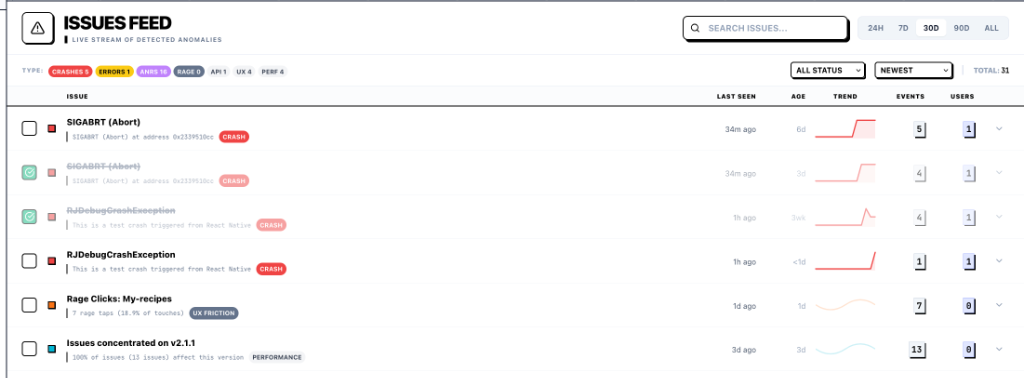
Revenue leakage has more than one shape
Billing reconciliation is an important form of revenue leak detection, but it is not the whole problem for web and mobile products.
Use a broader taxonomy:
| Leak class | Example | First evidence |
|---|---|---|
| Acquisition leak | High-intent traffic reaches the wrong experience | Source, route, journey, replay |
| Onboarding leak | New accounts never reach first value | Activation funnel, time to value, failed sessions |
| Conversion leak | Users begin a goal but cannot finish | Funnel transition, replay, heatmap, request data |
| Checkout leak | Payment or order state breaks | Payment state, API result, confirmation state |
| Subscription leak | Trial, upgrade, renewal, or entitlement fails | Subscription state, product behavior, payment events |
| Retention leak | Repeated friction precedes inactivity or cancellation | Cohort behavior, issue history, final high-intent sessions |
| Billing leak | Contracted, invoiced, and collected amounts disagree | CRM, billing, ledger, payment reconciliation |
Rejourney focuses on the product-side classes: the places where behavior and technical conditions prevent users from onboarding, converting, subscribing, or staying. It should complement—not invent—financial reconciliation.
Detect failed intent, not every anomaly
An anomaly is unusual. A leak is unusual behavior connected to a valuable outcome.
A spike in API errors on an unused background endpoint may be operational noise. A small error increase on the request that activates a subscription can be a serious leak. Similarly, a high drop-off after a documentation page is not automatically lost revenue; high drop-off after payment submission deserves immediate review.
A candidate leak begins with intent: the valuable outcome the user was attempting. Next, name the observable failure and the population affected. The final requirement is evidence from the journey, session, request, error, or payment state that supports the diagnosis.
Without intent, alerting becomes a generic issue feed. Without evidence, the revenue label becomes speculation.
Build detectors from several signal families
The strongest detectors combine signals that fail differently.
Journey and funnel signals
Look for transition loss, unexpected loops, repeated backtracking, or a path that changed after a release. Compare against the same step’s recent baseline and the healthy route.
Interaction signals
Rage taps, dead clicks, repeated form submissions, excessive focus changes, and long pauses can reveal that the interface did not confirm progress. These are clues, not causes.
Technical signals
Request failures, latency, JavaScript exceptions, crashes, ANRs, device pressure, and version concentration explain when the system shaped the outcome.
Business and payment signals
Checkout starts, payment attempts, authorization results, orders, subscriptions, entitlements, refunds, cancellations, and renewal outcomes connect product behavior to real commercial states.
No single family should dominate. Event analytics can report the missing outcome but not the experience. Replay can show the experience but not how often it occurs. Payment data can prove money moved but not why the user struggled before or after it.
Establish a clean healthy comparison
Detection requires a reference. “Thirty users failed” means little without knowing the normal population, seasonality, and release history.
Useful comparisons include: the same transition in the previous stable release; successful and failed sessions during the same time window; the affected device or country versus the rest of traffic; new users versus invited or returning users; and the same payment method or plan before and after a change.
Avoid treating the previous hour as universal normal behavior. Low-volume funnels need longer windows, and weekly usage patterns can create false alarms.
Score confidence separately from impact
Teams lose trust when every anomaly receives a dramatic revenue estimate. Keep evidence confidence and potential impact as separate fields.
One practical structure is:
affected intent = eligible sessions × observed excess failure ratepotential impact = affected intent × historical completion valueconfidence = signal agreement × sample quality × repeatabilityThe calculation is an estimate, not booked revenue. Label the window, denominator, baseline, and assumptions. A detector with high impact but weak confidence belongs in investigation. A moderate-impact detector with repeated replay and technical evidence may be ready for engineering.
Do not multiply every abandoned session by average revenue. Some users would not have converted even in a healthy flow. Estimate only the excess loss above a defensible baseline.
Turn the alert into a diagnostic packet
A useful revenue leak alert should reduce work, not create a scavenger hunt. Include: the affected outcome and transition; first seen, last seen, and trend; affected sessions, users, platform, release, and segments; healthy baseline and excess failure; and repeated interaction and technical signals.
Add representative failed and successful sessions; a plain-language hypothesis with confidence; and the metric that can verify recovery.
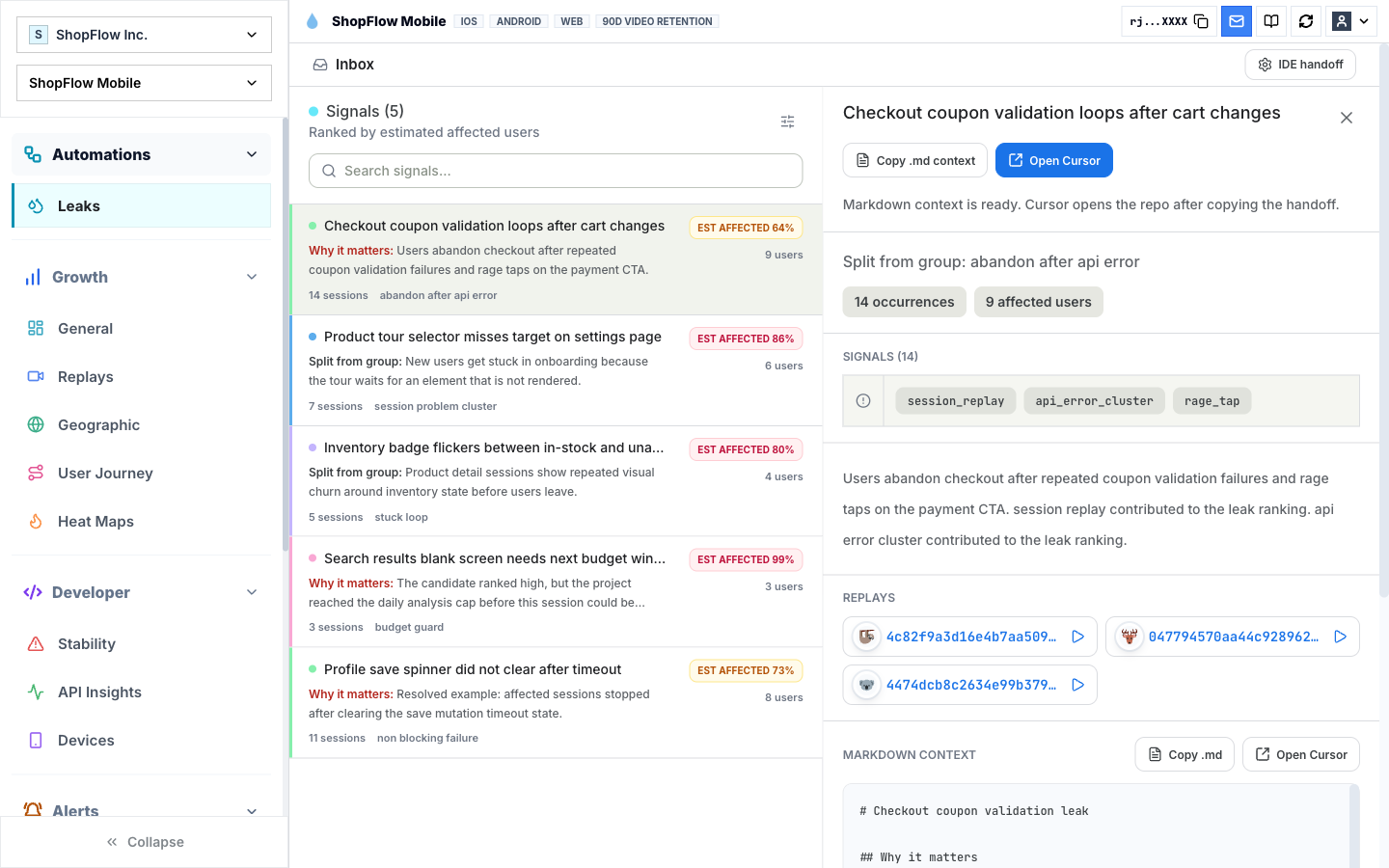
“Checkout revenue leak” is not enough. “Payment submission on mobile version 6.2 is followed by a 12-second confirmation timeout in 18 sessions; authorization succeeded in six of them, but the UI showed no receipt” gives product and engineering a place to start.
Prediction should mean earlier evidence, not certainty
Revenue leak prediction is valuable when leading signals appear before aggregate revenue moves. It does not require claiming perfect foresight.
Examples of leading evidence include: time to value increasing before activation rate falls; rage taps and API latency rising on an upgrade action; more checkout loops after a release; trial users completing setup but failing to reach the value event; and subscribers encountering repeated errors before cancellation.
The system can rank these conditions as risk because they have historically preceded failed outcomes or because they block a necessary state. Product teams should still inspect the evidence and verify the assumed relationship.
Close the loop after a fix
Detection without verification becomes an inbox. When the owner ships a change, keep the original cohort and transition attached.
Review: excess failure rate after the release; recovery in completion, activation, payment, or retention; time through the affected step; related support and technical signals; and whether the leak moved to another branch.
The recovered metric should match the original intent. Fixing rage taps is not the outcome; restoring successful upgrades is.
From a ranked leak to the affected session
Rejourney ranks a suspicious conversion change and keeps its supporting sessions close. Open the failed cohort, compare it with a healthy baseline, and inspect the journey alongside request and stability evidence. The alert remains an estimate until the underlying state and sessions support it.
The implementation differs by surface. See website revenue loss prediction or mobile app revenue loss prediction.