
Mobile app revenue rarely disappears in one clean event. The first signal may be an onboarding step that takes longer, a permission branch that stops recovering, a paywall that renders less often on one device, a store transaction that no longer refreshes entitlement, or an ANR during upgrade.
Aggregate revenue reacts after those sessions accumulate.
Revenue loss prediction for mobile apps means ranking leading product and runtime evidence that threatens activation, trial, purchase, subscription, or renewal—then attaching enough session context for the team to verify the risk before calling it a leak.
Predict a failed business state, not “revenue” in the abstract
Choose the outcome at risk: new-user activation; paywall reach; trial start; validated in-app purchase; and subscription creation.
Add entitlement delivery; first paid value; trial continuation or renewal; and retained core use.
Each outcome has different eligible users and leading signals. Combining them into one score makes ownership and verification unclear.
Map the mobile revenue path
Create a state map:
first open → onboarding → activation → paywall eligibility → paywall render→ store initiation → validated transaction → subscription → entitlement→ paid value → continuationAdd mobile branches such as permissions, deep links, external authentication, background and resume, restore purchases, device changes, crashes, and ANRs.
A detector should name the transition it believes is degrading. “App revenue risk” is an alert category. “Activated users on iOS 19 reach the upgrade paywall but fail to restore state after the store sheet closes” is an investigation.
Use leading signal families
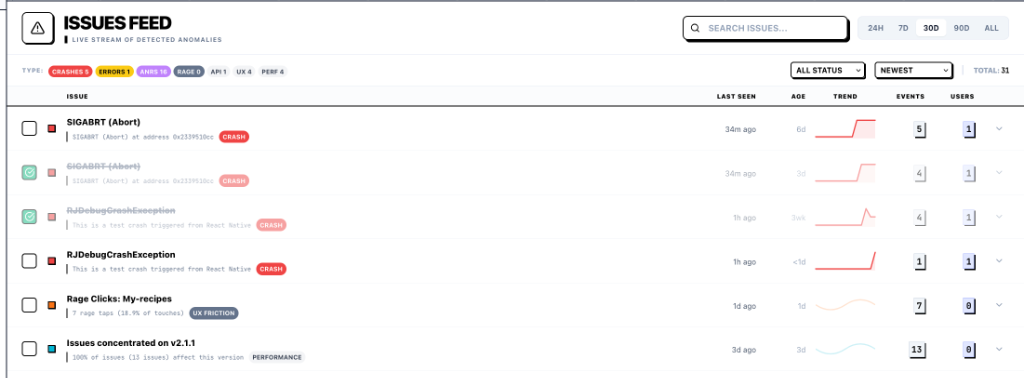
Behavior changes usually appear first. Users loop before activation, tap a conversion action repeatedly, or take longer to reach the first useful result. A falling share of eligible users reaching the paywall can expose an upstream onboarding problem before subscription revenue moves.
Runtime evidence makes that warning more specific. Check whether crashes, ANRs, request latency, or background-state loss concentrate on the same conversion path and app release. Device or memory pressure matters when healthy sessions from the same cohort do not show it.
Store and entitlement state can confirm the leak. Examples include purchase initiation without a validated result, an active subscription without access, or a successful restore that leaves the product locked. Retention evidence then shows the longer effect: paid users fail to reach value, core actions decline, or renewal recovery stops working.
Signal agreement increases confidence. A conversion decline, repeated replay pattern, and version-specific API failure form a stronger case than any one alone.
Detect change against a suitable baseline
Mobile traffic and store behavior vary by weekday, campaign, country, release adoption, platform, and device mix. Compare the affected transition against: the previous stable app version; the same platform and placement in a healthy window; unaffected devices or OS versions; successful and failed sessions during the same period; and equivalent acquisition and subscription cohorts.
Do not compare a newly launched country or product identifier with the global historical average and call the difference a leak.
Rank excess failure and evidence confidence separately
Estimate the population above baseline:
excess failed intent = eligible attempts × (current failure rate - healthy failure rate)Then score evidence confidence using repeatability, sample quality, state agreement, and technical support.
Potential revenue impact can use historical value for the same outcome when the assumptions are labeled. Do not multiply every exit by subscription lifetime value. Some eligible users would not have converted in a healthy experience.
Find device-specific revenue risk
Mobile leaks often hide in averages. Track transition loss and issue pressure by device model, OS, app version, screen size, platform, and network condition.
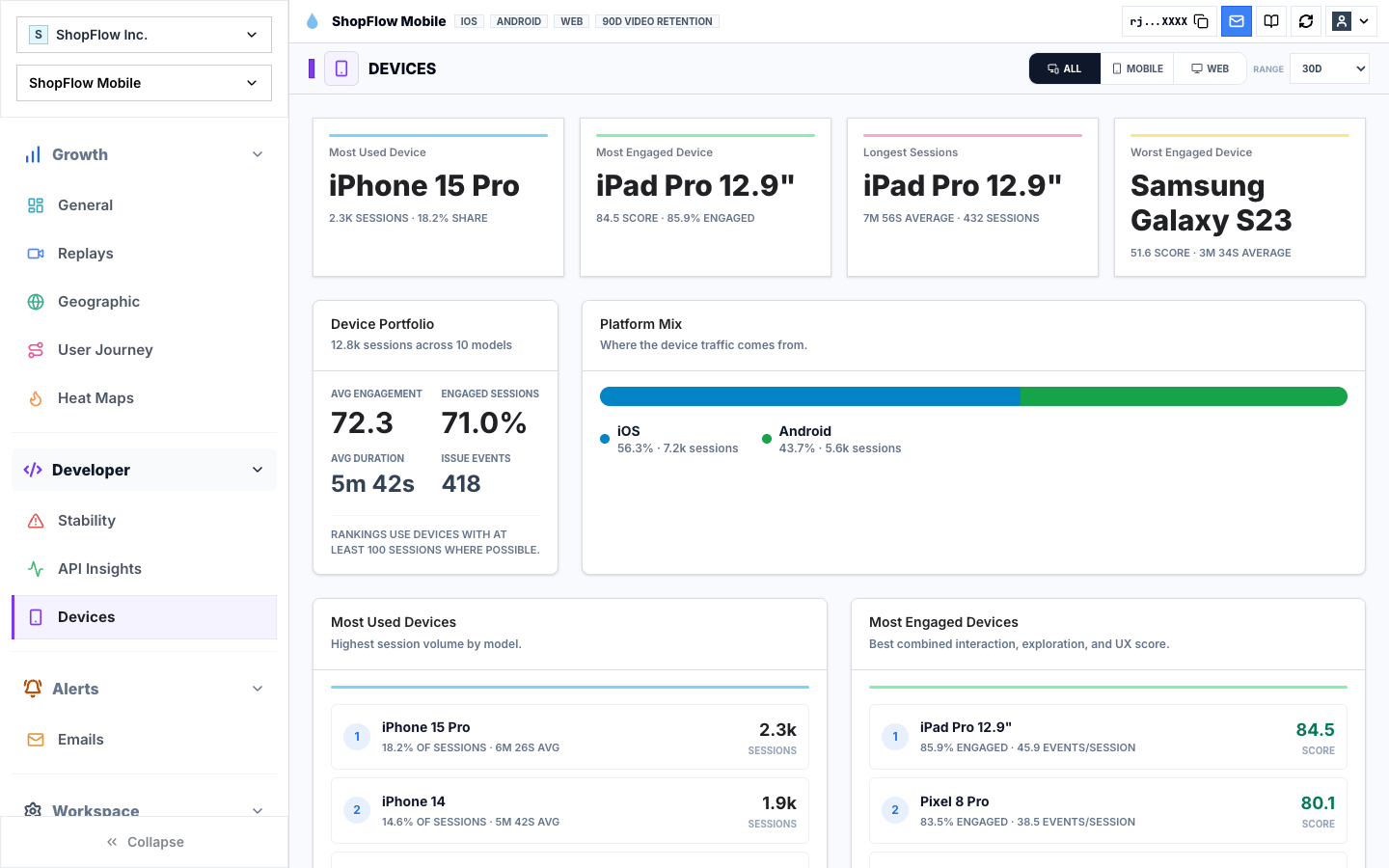
A small device cohort can carry severe customer harm. Rank both population impact and severity so low-volume payment contradictions or post-purchase lockouts remain visible.
Attach representative healthy and failed sessions
Every confirmed risk item should include sessions that share the same intended outcome and app context.
Review: touch and gesture sequence; UI acknowledgement and loading state; permission or store-sheet handoff; app background and resume; and API timing and result.
Review crash, ANR, and release context; subscription and entitlement state; and user recovery attempt.
Healthy sessions show what normal effort and timing look like. Failed sessions show whether the risk has a repeatable mechanism.
Treat state contradictions as high-confidence leaks
Contradictions require less behavioral inference: store purchase validated; entitlement missing; subscription active; paywall still blocks; trial started; product remains on free limits; restore reports success; content remains locked; and backend activation complete; app repeats setup.
These conditions should trigger reconciliation and attach the user experience for engineering. The commercial system remains authoritative; replay explains what the customer saw.
Predict before a release reaches everyone
Mobile release adoption creates a natural early-warning window. Compare the new version’s revenue-critical transitions with the prior stable version as traffic arrives.
Watch: onboarding activation and time to value; paywall render and store initiation; purchase validation and entitlement; crashes, ANRs, API failures, and device concentration; and trial and subscription continuation.
Use minimum sample requirements and confidence labels. Early detection should not turn a handful of sessions into a dramatic financial forecast.
Route the alert by mechanism
| Leading mechanism | Likely first owner |
|---|---|
| Permission or onboarding path | Mobile product and design |
| Crash, ANR, lifecycle, or device issue | Mobile engineering |
| API or validation failure | Backend and platform |
| Offer, placement, or value timing | Growth and product |
| Store, subscription, or entitlement contradiction | Monetization engineering |
| Renewal or recovery failure | Billing and lifecycle |
The alert should reduce triage time, not send every app conversion change to growth.
Verify recovery using the original transition
After a fix, reopen the same version, device, placement, trigger, and business state. Check: excess failure; repeated interaction and technical signals; validated purchase or activation; entitlement and first paid value; trial continuation, renewal, and retention guardrails; and whether another branch became the new failure.
Recovered revenue is a healthy outcome that actually occurred, not the estimated value attached to an alert.
Review the sessions behind an app revenue warning
A revenue warning in Rejourney includes the affected app transition and sessions from the concentrated cohort. Product and engineering can compare failed and healthy journeys from the same release while checking store, entitlement, request, crash, and ANR evidence.
The underlying measurement is described in mobile app conversion funnels and the general revenue leak detection guide.