
An app subscription exists across several systems at once. The store knows the transaction. A backend may validate it. A subscription service tracks status. The app controls what the user can access. Product analytics knows whether the paid capability delivers value.
If those systems are analyzed separately, teams can report a successful purchase while the user remains locked out—or report a failed conversion when the store completed the transaction after the client timed out.
In-app subscription analytics should connect product value, paywall exposure, store outcome, validation, subscription, entitlement, paid use, renewal, and churn.
Define the subscription states
Use business states that can be reconciled: eligible for offer; paywall exposed; trial or purchase initiated; store transaction pending, purchased, canceled, or failed; and transaction or receipt validated.
Include subscription trialing, active, grace, paused, expired, or canceled as supported; entitlement active or inactive; first paid capability used; renewal attempted and completed; and refund, revocation, or plan change.
Keep platform and product identifiers normalized. The names displayed in the app can change while the underlying commercial state remains consistent.
Join systems through safe identifiers
The app session, internal user or account, store transaction reference, subscription, and entitlement should be traceable without exposing payment credentials or sensitive store data in replay.
Use controlled backend joins and safe references. Behavioral tools should receive only the context needed to explain the product experience.
This identity model makes contradictions, retries, restore flows, and cross-device access visible.
Build several subscription funnels
First purchase or trial
eligible → paywall → store initiation → validated state → entitlement → first paid valueTrial continuation
trial active → value received → renewal eligible → paid renewal → continued entitlementRestore
restore intent → store result → validation → entitlement → visible accessPlan change
change intent → offer selected → store result → subscription update → new entitlementRenewal recovery
renewal failed → user informed → method or store state updated → paid → entitlement healthySeparate funnels produce clearer denominators and owners.
Measure product value before and after purchase
A subscription event does not prove the user understood or received value.
Track: activation before first paywall; core actions before trial or purchase; time from purchase to first paid value; repeat paid capability use; trial continuation; renewal and retained value; and early cancellation and refund.
Compare subscribers who reached value before the paywall with subscribers who bought before activation. The result informs onboarding and paywall timing, not just pricing.
Reconcile validated transaction and entitlement
Monitor contradictions: store purchased; validation missing; validation succeeded; subscription absent; subscription active; entitlement inactive; entitlement active; UI still locked; trial active; app shows expired state; refund or revocation; access unchanged beyond policy; and plan changed; old limits remain.
These are high-confidence product and revenue leaks. Reconciliation should be automated where safe, with affected sessions available for engineering review.
Analyze store outcomes without overinterpreting them
Keep outcome categories such as purchased, canceled, pending, unavailable, verification failed, and unknown or interrupted.
A user-canceled store sheet does not reveal why. Use the app journey and replay around the sheet: Was the selected offer correct? Did the app explain the price and trial? Did the system sheet return to a coherent state? Did the user retry, choose another plan, or leave? Did a backend result arrive after the client reported failure?
The app cannot and should not record private system-sheet content.
Treat restore as a paid-user experience
Restore analytics should measure successful access, not only the store response.
Track restore visibility, attempts, result, validation, entitlement refresh, and time to unlocked content. Review repeat attempts and sessions where restore succeeds but the product remains gated.
A failed restore may not reduce new purchases, but it can create refunds, support contacts, poor reviews, and churn among existing subscribers.
Segment subscription outcomes meaningfully
Compare by: platform and store; app version and OS; device class; product and offer identifier; and paywall placement and experiment.
The same analysis should cover trial length or type; new, returning, and restored subscriber; country and currency where appropriate; and activation and issue history.
Do not compare different commercial motions as if they share one baseline.
Connect crashes and API failures to subscription state
Crashes, ANRs, network failures, and delayed validation can interrupt commercial flows or access.
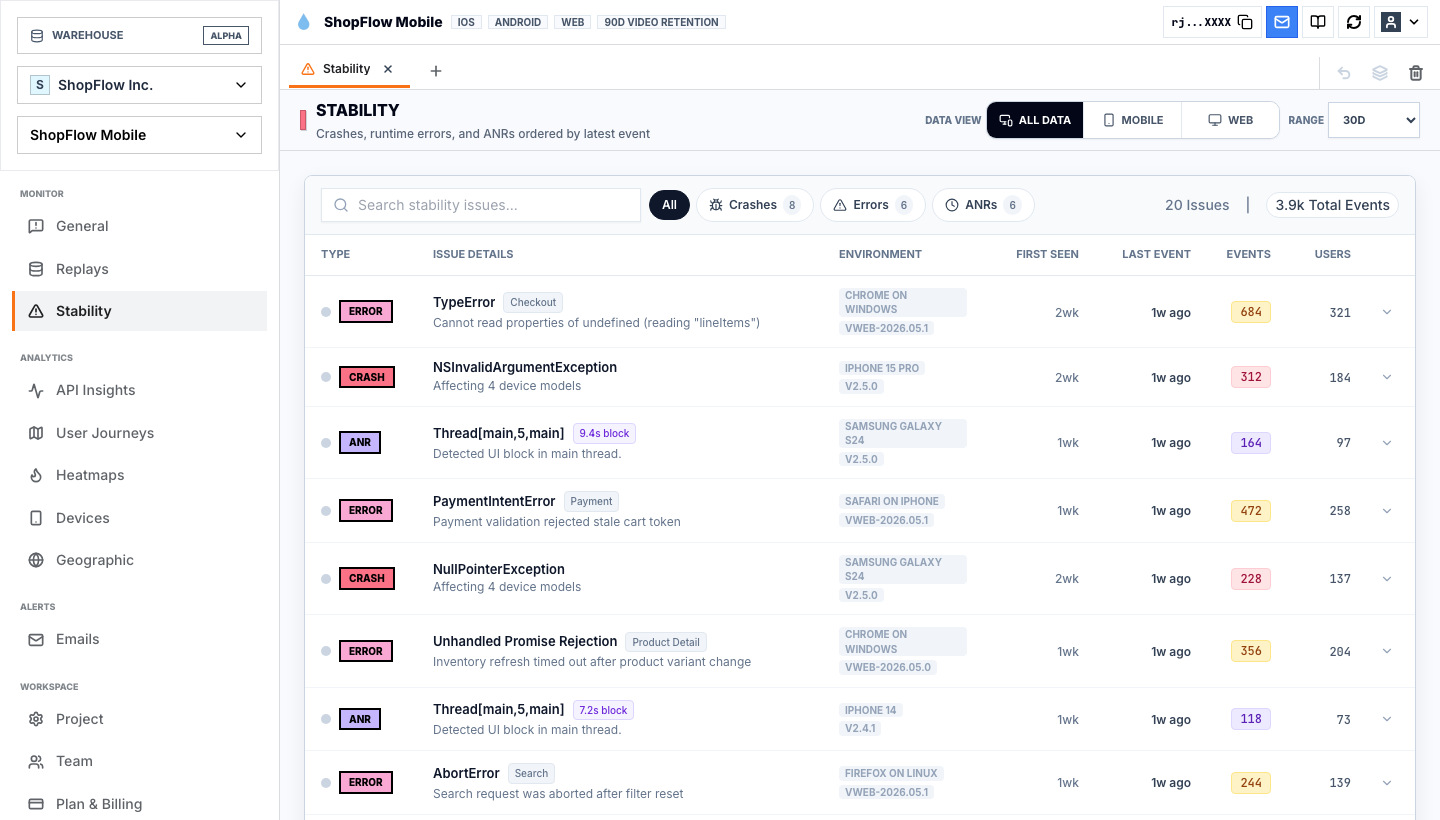
Attach app release, device, session, store outcome, and safe subscription state. A spike in errors matters more when it blocks validated entitlement or renewal recovery.
Measure trials as product cohorts
For each trial cohort, track: activation before and during trial; time to first value; paid capability use; repeated friction; and paywall and plan path.
Add conversion to paid state; entitlement continuity; and early renewal, cancellation, or refund.
Do not wait until the trial ends to investigate. Increasing time to value, failed paid actions, or repeated app issues can signal conversion risk while there is still time to fix the product.
Report revenue states honestly
Separate: attempted purchase value; validated purchase value; active subscription value according to your business rules; refunded or revoked value; value at risk in a defined grace or recovery state; and recovered value after a healthy paid state returns.
Deduplicate retries and respect store reporting rules. Product analytics can connect revenue states to behavior but should not replace the financial system of record.
A subscription incident workflow
- Identify the failing commercial transition
- Reconcile store, validation, subscription, and entitlement
- Compare app version, platform, device, offer, and placement
- Open healthy and failed sessions from the same motion
- Inspect app lifecycle, store return, API, crash, and visible state
- Fix or reconcile the mechanism
- Verify first paid value and downstream continuation
This prevents a subscription-state incident from becoming only a paywall redesign or lifecycle campaign.
Keep store and product state in one investigation
Rejourney follows the app journey around the store sheet and the entitlement result that follows it. A purchase event is useful, but the surrounding session reveals whether the offer rendered correctly, the app recovered after cancellation, and paid access appeared when the transaction completed.
Use mobile paywall analytics for the decision screen and payment failure analytics for recovery paths.