
A payment can fail before it reaches the processor, at the issuer, during authentication, after authorization, or only in the interface the user sees. Grouping those outcomes under one payment_failed event hides both the fix and the recoverable revenue.
Payment failure analytics should reconstruct the entire attempt:
user intent → payment submission → processor result → business state → visible outcome → recoveryWhen any link is missing, teams can send the wrong message, retry the wrong operation, or tell a customer to update a card that was successfully charged.
Give every attempt one traceable identity
The client event, backend request, processor object, invoice or order, subscription, and session should be joinable without exposing sensitive payment data.
Capture identifiers that are safe for your architecture, such as an internal payment-attempt ID, order ID, invoice ID, session ID, and processor object reference. Keep card numbers, security codes, tokens, bank details, and raw sensitive payloads out of product analytics and replay.
An attempt ID makes several difficult cases visible: the user pressed Pay twice while the first request was still running; authorization succeeded but the client timed out; the webhook arrived after the UI reported failure; the order was created twice or not at all; a retry reused stale state; and the user recovered with a different method.
Counting button clicks cannot answer those questions.
Create a failure taxonomy the team can act on
Start with categories that point to different owners and recovery paths.
| Category | Examples | Likely response |
|---|---|---|
| Input or validation | Missing field, unsupported format, invalid expiry | Improve validation and preserve input safely |
| Issuer decline | Insufficient funds, restricted card, generic decline | Explain next step and offer another method |
| Authentication | Challenge failed, abandoned, callback lost | Restore state and allow safe retry |
| Processor or network | Timeout, 5xx, connection failure | Retry carefully, monitor provider, preserve idempotency |
| Application consistency | Authorized but no order or entitlement | Reconcile server state immediately |
| Interface state | Request completed but UI showed no result | Fix feedback, polling, and recovery path |
| Renewal failure | Stored method failed on recurring charge | Dunning, account state, and entitlement policy |
Do not expose detailed fraud or security reasons to the user when the processor advises a generic response. The analytics taxonomy can be more specific internally while the UI remains safe.
Track rates at the correct denominator
One “failure rate” often mixes first attempts, retries, new checkouts, renewals, and recovery attempts.
Submission success measures accepted payment requests against valid submissions. Authorization success uses the attempts actually sent for authorization. After authorization, measure whether an order or subscription was created and whether the completed business state produced a visible confirmation. Recovery needs its own rate and clock: the share of eligible failed customers who later reach healthy paid state, and the time from first failure to that state.
For subscriptions, separate new purchase, plan change, scheduled renewal, and manual recovery. Their user intent and available recovery window are different.
Reconcile processor truth with application truth
The most dangerous payment failures are contradictions.
The clearest examples are direct contradictions. The processor says authorized while the application says failed. An invoice is paid but entitlement remains inactive. A subscription is active while the workspace is locked, or an order exists while the client offers another attempt. Refund state and product access can disagree in the same way.
Build a reconciliation job or report that compares these states. Behavioral analytics can show the user impact, but the payment and billing systems must remain the source of truth for money movement.
When a contradiction appears, attach the affected sessions so engineering can see what the user was told. The financial fix and the trust fix may both be necessary.
Pair the decline code with the experience
Two users can receive the same issuer decline and have very different recovery outcomes. One sees a clear message, changes the method, and completes. The other sees a spinner disappear with no explanation and leaves.
In replay, first check whether the button acknowledged submission and whether the form preserved safe, non-sensitive inputs. The error should appear near the action and name a reasonable next step. Then inspect alternative methods and retry behavior for duplicate loading or stale totals. On mobile, the keyboard, focus, or viewport can hide an otherwise useful message.
Replay must mask payment fields and sensitive personal data. The goal is to inspect interaction state around the form, not collect credentials.
Distinguish checkout recovery from dunning
Failed-payment recovery covers two separate moments.
Active checkout recovery
The user is present and showing intent. The product can offer another method, restore an authentication flow, explain a retry, or safely confirm an already completed purchase. Fast, unambiguous feedback matters.
Renewal recovery
The charge occurs without the user present. Recovery involves notification timing, account state, grace periods, retry policy, method updates, and the experience when the user returns.
Do not compare these with one conversion rate. Checkout recovery is session-based; renewal recovery often spans days and multiple channels.
Find technical failures that look like buyer choice
If the client never receives a result, a standard funnel may record an exit rather than a payment failure. Connect request telemetry to the payment state and session.
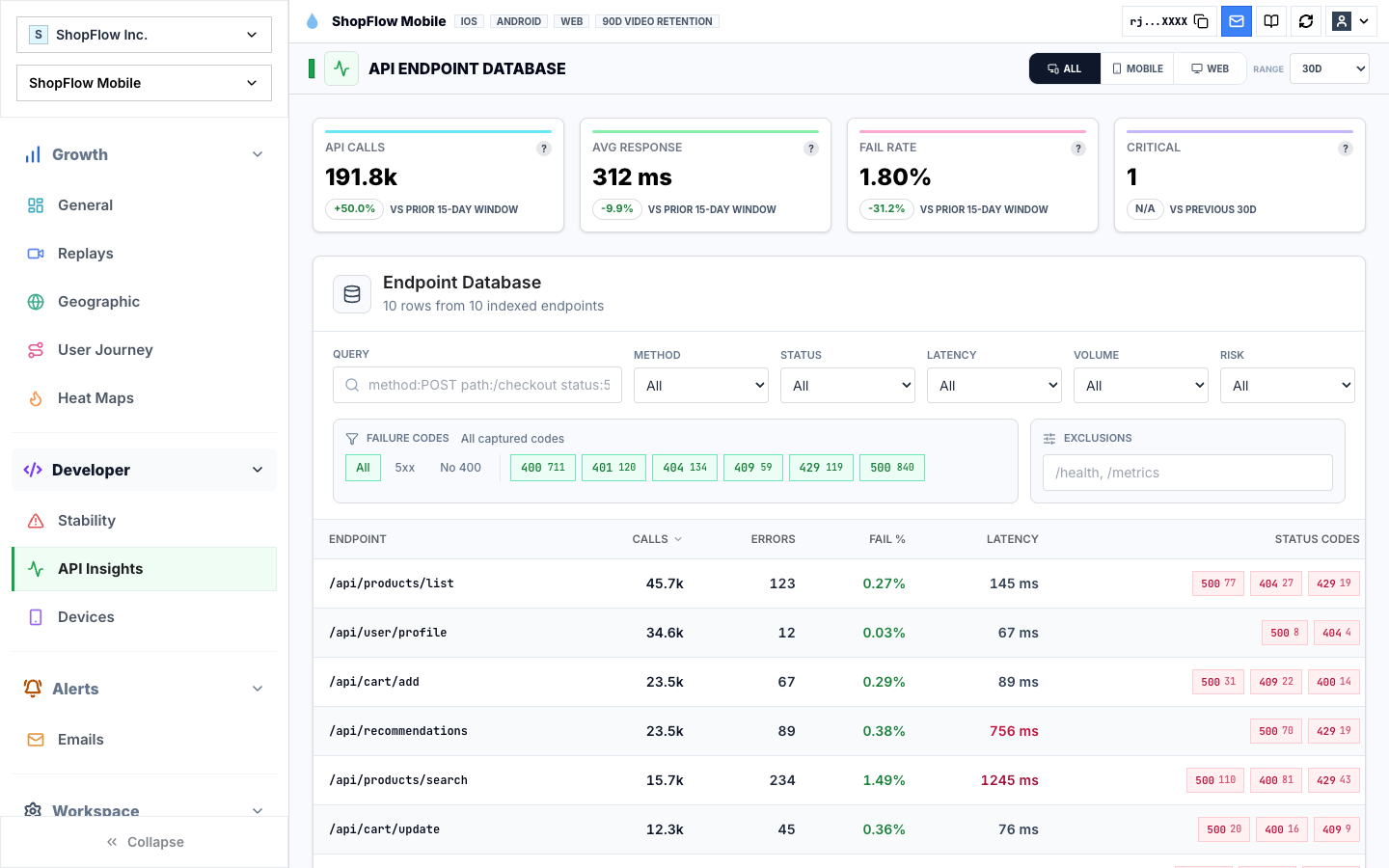
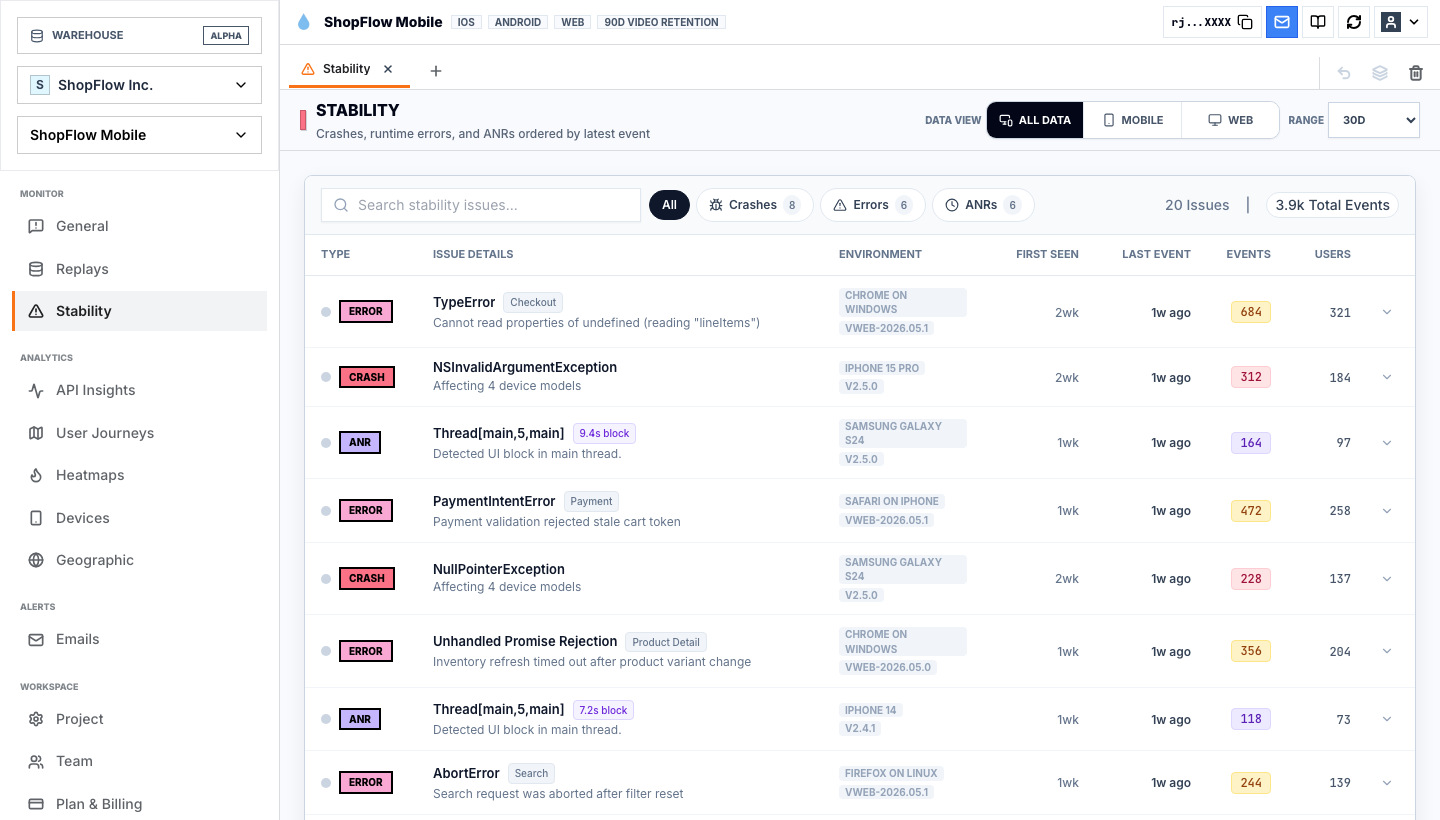
Watch for: increased latency before abandonment; a release-specific rise in 4xx or 5xx responses; callback routes that lose checkout context; mobile crashes or ANRs during authentication; webhook delivery delays that postpone entitlement; and country, browser, device, or app-version concentration.
A technical pattern should produce an engineering investigation, not a new lifecycle email.
Estimate revenue at risk without inflating it
Payment value is available, which makes exaggerated dashboards tempting. Do not count every failure as lost revenue.
Attempted value is the amount attached to failed attempts. Only the portion with a valid recovery path should be labeled recoverable. Once it reaches confirmed healthy state it becomes recovered; while it remains inside the defined window it is unresolved. Label value as lost only after that recovery window closes without payment.
Deduplicate repeated attempts for the same intended purchase. Otherwise, one user pressing Pay three times can triple the apparent leak.
A practical investigation order
When payment conversion changes, review in this order:
- Confirm processor, order, subscription, and entitlement state agree
- Separate new checkout, upgrade, renewal, and recovery attempts
- Break down failure categories and latency
- Compare release, platform, country, method, and device
- Open failed and recovered sessions from the largest category
- Verify the message and next action the user received
- Assign the financial, engineering, and UX owners where needed
This order protects customers who may already have paid before the team starts optimizing a form.
Trace payment failure back to the user journey
Rejourney places payment-adjacent requests and application state beside the user session. The team can see whether a decline was explained, whether retry remained safe, and whether payment, order, and entitlement ended in agreement.
Use checkout funnel analytics for active purchases and subscription funnel analytics for recurring payment state.