
Most checkout reports compress very different outcomes into one word: abandonment. A buyer who rejects the final price, a buyer whose payment is declined, and a buyer who successfully pays but never sees confirmation can all disappear at the same step.
They should not produce the same work.
Checkout funnel analytics becomes useful when it preserves the difference between intent, interface state, payment state, and order state. The goal is not merely to show where conversion fell. It is to tell the team what kind of leak occurred and which sessions prove it.
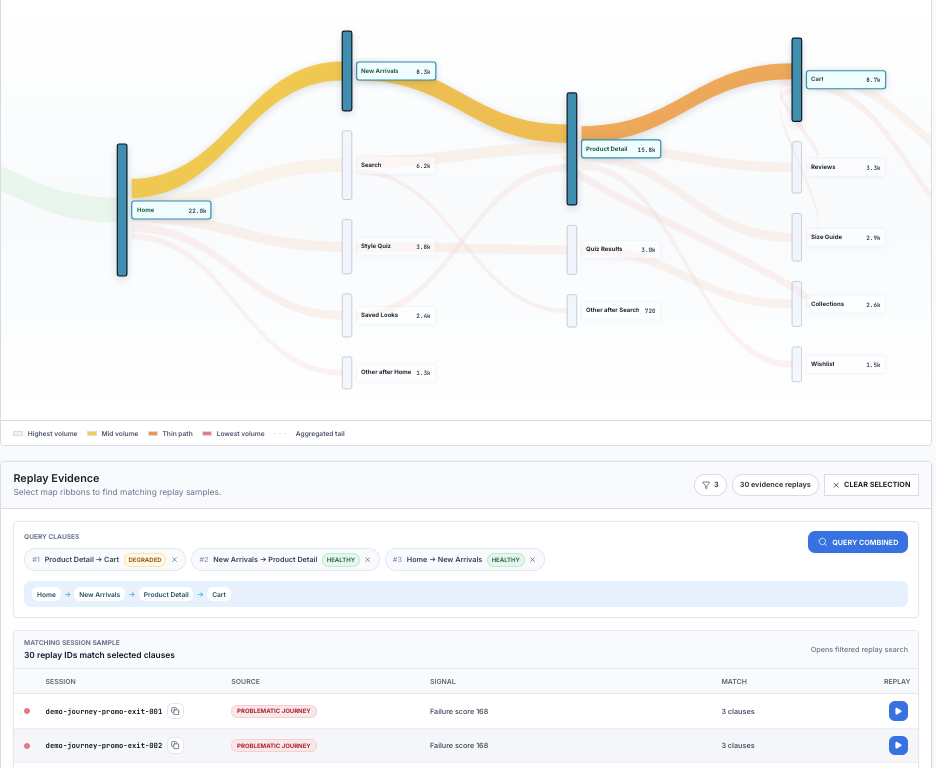
Start with a state machine, not a list of pages
Modern checkout rarely follows one clean route. Express checkout can skip address entry. Returning customers may have saved payment methods. Authentication challenges can leave and return to the site. Taxes or shipping may be calculated asynchronously.
Define checkout as states that the business and application agree on:
- Checkout eligible
- Checkout started
- Contact or account confirmed
- Fulfillment choice confirmed, when relevant
- Payment method submitted
- Payment authorized
- Order or subscription created
- Confirmation presented
The last three states deserve special attention. Authorization can succeed while order creation fails. The order can exist while the confirmation page fails. A client-side “purchase complete” event can be blocked even though the server recorded revenue.
Reconcile client behavior with server truth before calling a user lost.
Calculate loss between business states
The basic transition formula is simple:
transition conversion = users reaching next state / users entering current statetransition loss = users entering current state - users reaching next stateThe difficult part is the denominator. Use eligible users for the question you are asking. If the payment step excludes buyers whose location cannot be served, including them in payment conversion turns a business rule into apparent UX friction.
Keep these rates separate:
| Rate | Denominator | Why it matters |
|---|---|---|
| Checkout start rate | eligible sessions | Measures intent to begin |
| Checkout completion rate | checkout starts | Measures flow performance |
| Payment authorization rate | payment submissions | Measures processor and issuer outcomes |
| Order creation rate | authorized payments | Finds post-payment consistency failures |
| Confirmation presentation rate | created orders | Finds trust-damaging UI or delivery failures |
If only overall conversion is tracked, a payment-provider incident and a confusing shipping policy can look identical.
Tag the reason without pretending you know the cause
Analytics events should record observed facts. Avoid labels such as user_confused or price_too_high unless the user explicitly provided that feedback.
Useful observed signals include: validation message displayed; promo code rejected; shipping or tax recalculated; payment request failed or timed out; and issuer decline category.
Also examine authentication challenge started and returned; primary action tapped repeatedly; back navigation after total changed; confirmation request failed; and page or app backgrounded.
These signals form hypotheses. Replay, request timing, and successful comparisons establish the likely cause.
Review healthy and failed sessions together
Opening only abandoned checkouts creates confirmation bias. The failed session may contain behavior that is normal in successful purchases.
For the largest leaking transition, sample: successful sessions from the same route and platform; failed sessions with a technical signal; failed sessions without a technical signal; and sessions from before and after the latest release.
Compare how many attempts the step takes, whether totals change, how long the response takes, and which UI feedback appears. A spinner lasting four seconds may be harmless when the next state is obvious and damaging when the button remains enabled with no acknowledgement.
Split checkout loss into four working queues
A useful triage turns one drop-off number into distinct queues.
1. Commercial hesitation
Examples include a newly visible fee, delivery date, minimum commitment, renewal term, or missing trust information. Replay may show the user reading totals, opening policies, moving back to plan selection, or leaving after a price change.
2. Interaction friction
Examples include unclear fields, keyboard obstruction on mobile, repeated validation, disabled controls, focus loss, or a promo interaction that resets the form.
3. Technical failure
Examples include API errors, latency, stale inventory, JavaScript exceptions, crashes, ANRs, or an authentication callback that does not restore state.
4. Payment outcome
Issuer declines, authentication failures, invalid payment details, processor errors, and duplicate-submission protection belong here. They need payment-specific handling rather than a general redesign.
The queues can overlap. A technical delay may create interaction friction, and poor recovery copy may turn a recoverable decline into abandonment. Keep the primary observed failure and attached evidence rather than forcing one universal label.
Treat confirmation as part of conversion
Teams often stop the funnel at payment success. The user does not.
A missing or delayed confirmation can lead to retries, duplicate support contacts, refunds, or distrust. Track the path from authorization to visible confirmation and include order lookup, email delivery, or entitlement creation when they are essential to the promise.
If payment succeeded but confirmation failed, do not optimize the payment form. Fix state reconciliation and give the user a safe way to recover their receipt or access.
Use API latency in product language
An endpoint dashboard should connect requests to the checkout state they affect. “POST /v1/confirm p95 increased” is operationally useful; “12% of payment submissions waited more than the UI timeout before confirmation” is actionable across product and engineering.
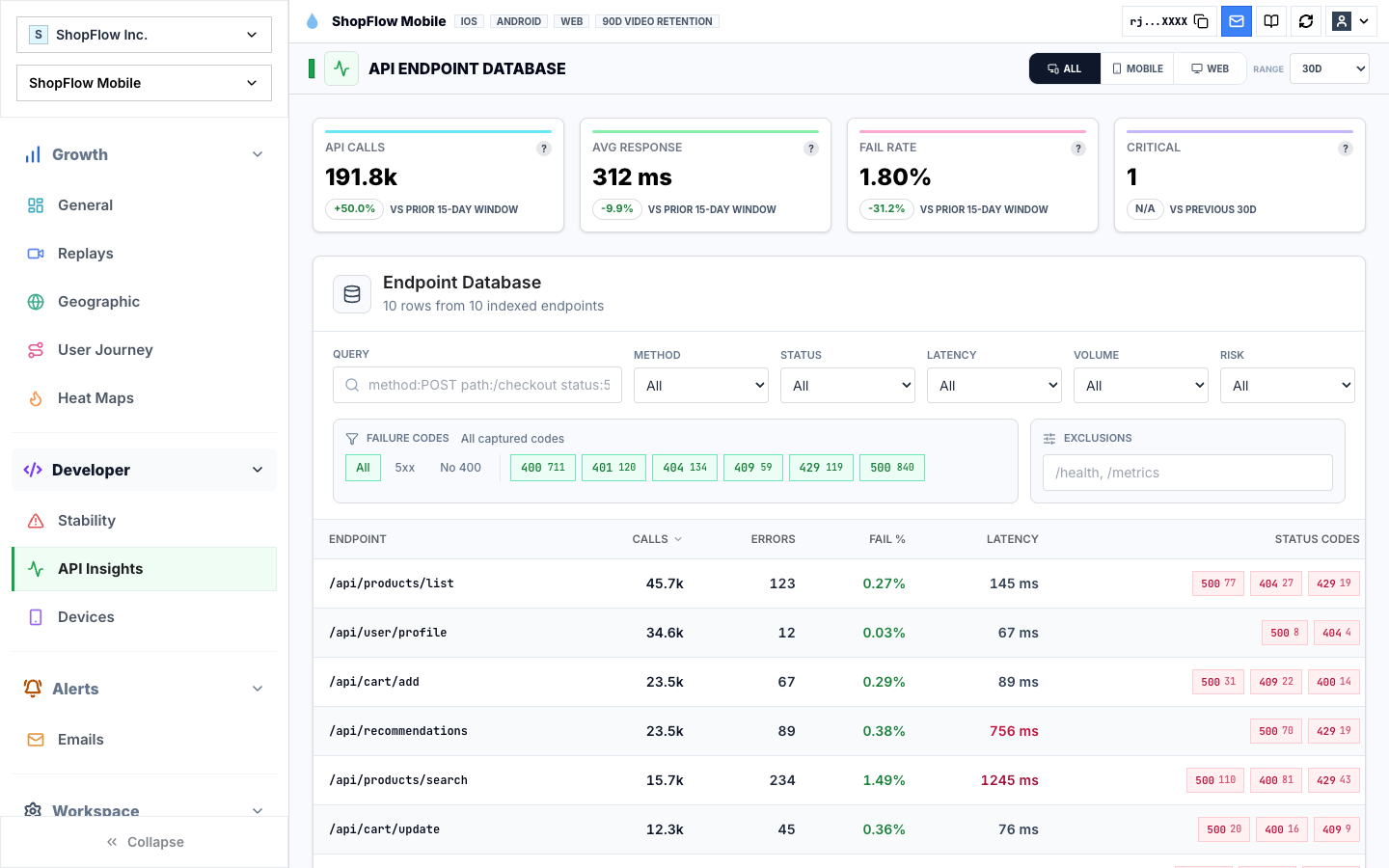
Capture sanitized context such as endpoint family, method, latency, status category, release, route, session, and checkout state. Do not put card data, tokens, addresses, or sensitive request bodies into behavioral analytics.
Prioritize by recoverable intent
Raw drop-off volume tends to prioritize the top of the funnel. Checkout work should account for intent and likely recoverability.
A simple ranking model can combine:
priority = affected checkout starts × estimated completion value × evidence confidence × recoverabilityThis is not a financial forecast. It is a disciplined way to compare a widespread but ambiguous exit with a smaller, well-proven defect on the final action.
Evidence confidence should be highest when the same observed failure repeats across sessions and technical signals. It should be lower when the only evidence is leaving the page.
Verify the fix beyond the conversion rate
After shipping, watch the specific transition and the side effects: Did step conversion improve for the affected cohort? Did payment retries or duplicate submissions change? Did time through checkout improve? Did support contacts, refunds, or cancellations move? Did another branch become the new failure point?
A faster flow that creates more mistaken purchases is not a clean win. A fallback that raises completion but hides payment uncertainty may move the cost into support.
Open the sessions behind checkout loss
A checkout report in Rejourney can lead straight to the sessions represented by a failed transition. Compare a payment attempt that stalled with a completed order from the same release and device. The difference often shows whether the customer hesitated, the interface stopped responding, or the application lost agreement with the payment and order systems.
Use the related checkout conversion guide when the failure is understood and the team is ready to test a change.